Active Recall Beats Passive Review Under Exam Pressure
Replace hours of passive rereading with targeted retrieval blocks you can instantly verify, measure, and aggressively repeat.
The Illusion of Competence in Passive Rereading
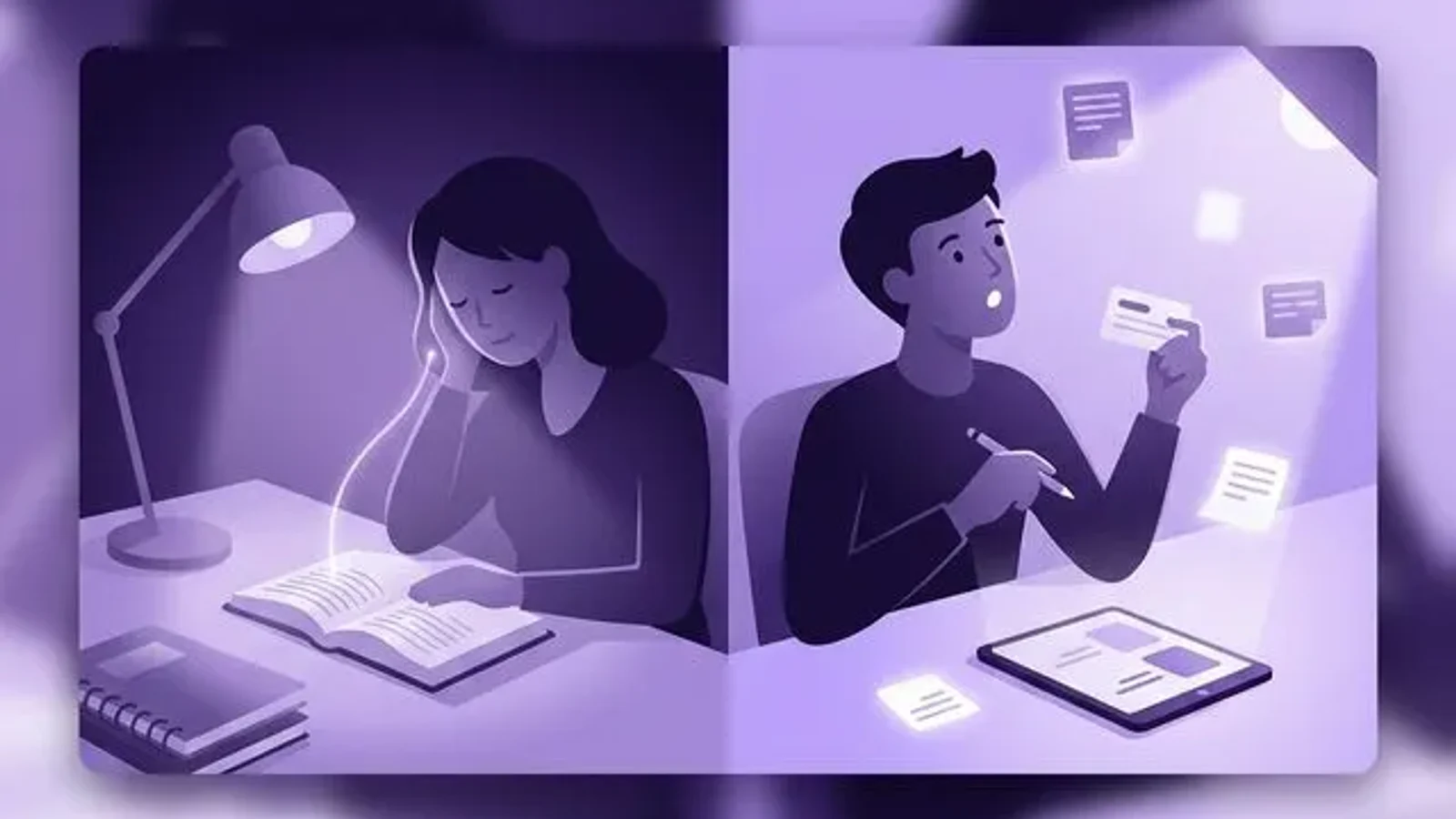
For generations, the default study methodology for college students has been breathtakingly simple: read the textbook, highlight the important parts, and then reread those highlights until the exam. It feels incredibly productive. Spending three hours scanning a chapter creates a warm, comforting sense of familiarity with the text. But familiarity is not mastery, and this is where rereading catastrophically fails.
Cognitive psychologists refer to this phenomenon as the 'illusion of competence.' Because the words on the page flow easily into your mind, you assume your brain has stored them for future retrieval. However, recognizing a concept when it sits right in front of you on a highlighted page is vastly different from generating that concept from scratch when staring at a blank exam paper.
Rereading does not stress the brain. It is the cognitive equivalent of watching someone else lift weights at the gym and assuming you are getting stronger. To build actual memory pathways, you must induce desirable difficulty. You have to force your brain to struggle, to search, and to pull the answer out of the void. If you want to know how to active recall effectively, you must first completely abandon the safety net of having the answers directly in front of your eyes.
The shift away from passive reading is often uncomfortable. It forces you to confront what you do not know immediately, rather than discovering your gaps during the actual midterm. But embracing this discomfort is the only proven way to solidify your long-term retention and ensure that you can perform under intense academic pressure.
Breaking Down the Active Recall Method
At its core, the active recall method is fiercely simple: test yourself before the exam tests you. Instead of putting information into your brain (reading), you demand that your brain outputs information (retrieving). This can take many forms: using flashcards, closing the book and writing down everything you remember, or explaining the concept aloud to an empty room.
The mechanics of active recall rely on strengthening the neural pathways used to access a specific memory. Every single time you successfully retrieve a piece of information without looking at your notes, that pathway thickens. Over time, the retrieval process becomes faster, more accurate, and resistant to exam anxiety.
To correctly implement this, your study sessions must be structured as testing events. If you study for sixty minutes, fifty of those minutes should be spent trying to recall answers to questions, not reading paragraphs. You should only refer back to your original notes or the textbook when you completely fail to retrieve the answer.
This methodology also provides instant feedback. When you reread, it is very difficult to know exactly when to stop. When you use retrieval practice, the feedback loop is immediate and binary: you either produced the correct answer, or you didn't. This prevents you from wasting time studying concepts you already know, allowing you to focus your limited cognitive bandwidth purely on your weakest areas.
Scaling Your Workflow with an Active Recall App
While you can perform retrieval practice using physical paper flashcards, managing hundreds or thousands of index cards quickly becomes a logistical nightmare for a full-time student. This is where technology drastically improves the execution of the strategy. Transitioning to a dedicated active recall app allows you to digitize, organize, and automate your testing.
An optimized app removes the friction of organizing your decks. You don't have to worry about carrying heavy stacks of cards to the library or losing track of which concepts you struggled with yesterday. The software handles the scheduling, presenting you with the exact questions you need to answer on any given day. This ensures that you are consistently testing yourself without having to manually track your progress.
Furthermore, the recent integration of large language models has created the active recall ai capability. These advanced tools don't just hold your flashcards; they can actually generate the test questions directly from your class notes or PDF textbooks. This completely eliminates the tedious setup phase, allowing you to jump straight into the retrieval practice.
By relying on intelligent software, you ensure that every minute you spend studying is spent pulling information out of your brain. The app prevents you from falling back into the comfortable, passive habit of just glancing over your notes.
The Active Recall Execution Checklist
Knowledge is useless without execution. To permanently replace rereading in your academic life, you need a rigid protocol.
Follow this checklist during every study block to ensure you are maximizing memory retention.
- Complete your initial reading or lecture attendance to establish baseline context.
- Immediately close the book or laptop and write down 3-5 core concepts from memory.
- Convert those core concepts into direct questions within your active recall app.
- Test yourself immediately on those questions, forcing an answer before turning over the card.
- Refuse to reread the source material unless you definitively fail the retrieval attempt.
FAQ
How to active recall when the subject is heavily math-based?
For quantitative subjects, retrieval practice means solving problems from scratch without looking at the solution manual. Make a flashcard that displays the base equation or the word problem. The act of performing the steps purely from memory is the active recall. Only look at the solution if you are completely stuck.
Is it exhausting to use the active recall method all the time?
Yes, initially it feels significantly more draining than rereading because it requires intense cognitive effort. However, because it is so highly efficient, you will actually spend fewer total hours studying. The fatigue is proof that actual mental adaptation and learning are occurring.
Can an active recall app replace my textbook entirely?
No, an app is a testing environment, not an initial learning environment. You still need the textbook or lecture to encounter the material for the first time and understand the broad context. The app simply replaces the review phase of your studying.
Is active recall ai generation accurate enough for medical or law school?
Yes, provided you feed the AI high-quality source notes. While the generation is excellent, students in highly rigorous programs should always do a quick quality control pass on generated cards to ensure no subtle legal precedents or clinical nuances were mistakenly abbreviated.
Active Recall vs Rereading: How to Active Recall for Higher Scores
Compare active recall and rereading to discover why a retrieval-first study workflow delivers highly measurable retention.