Build a practice exam that reveals what you still need to learn
A practical blueprint for turning notes into a checked mock test, with marks, a sample allocation, and a correction loop.
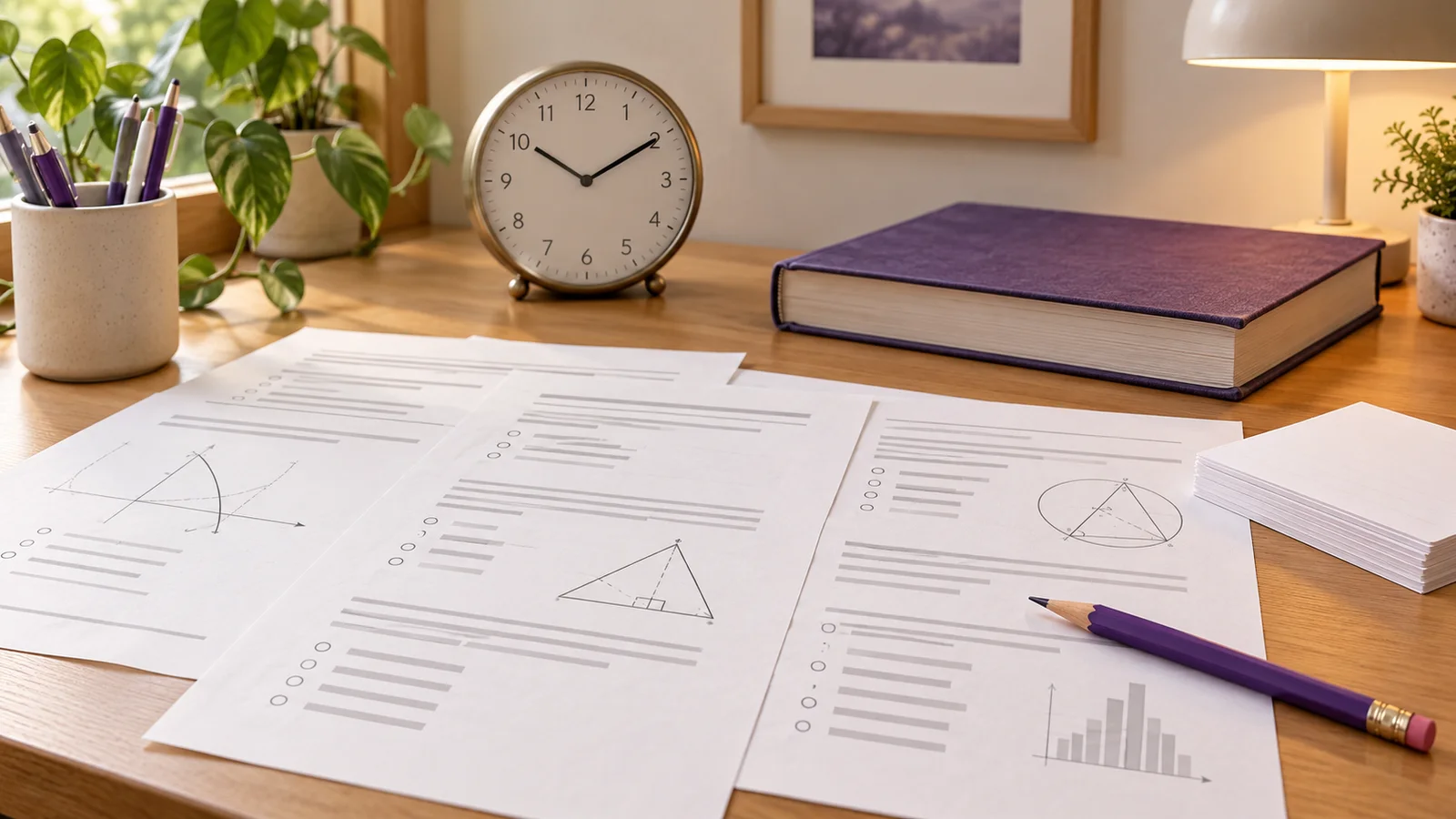
Map the test before writing questions
Use the syllabus, learning objectives, and any instructor-provided sample paper to establish scope. List each objective and the type of response it needs. Your generated test should practise that scope, not predict confidential exam questions.
Cornell recommends matching practice-test conditions and permitted resources to the real assessment. Use official practice papers when available. A test you create from notes is a supplement, especially when your notes omit parts of the course.
Use a small blueprint with explicit marks
Here is an original sample for a 30-minute, 20-mark revision test: four definition questions worth one mark each, two comparison questions worth three marks each, and two application questions worth five marks each. Allocate roughly five, ten, and fifteen minutes respectively, then adjust after a trial.
Check the arithmetic: 4 + 6 + 10 = 20 marks. Allocate questions across the actual learning objectives rather than assigning equal space to every heading. If the real exam is essay-based, use an essay plan and rubric instead of forcing this sample structure onto it.
Draft questions and check the answer key separately
A drafting request might be: “Using only this note, propose questions for these objectives. Put answers in a separate section, show the source passage, and flag missing evidence.” In Brainote, use the note’s quiz or chat tools for drafts, then assemble the mock paper and timing separately.
Read every question before sitting the test. Reject ambiguous wording, duplicate questions, and answers the source cannot support. Check numerical solutions yourself. For example, with 2, 3, and 10, the mean is 5 and the median is 3. A five-mark application should reward explanation and method, not merely a final number.
Sit the paper without leaking the answers
Keep the answer key out of sight. Use only the aids permitted in your actual assessment, and set your own timer. Brainote-generated questions do not imply a built-in timed exam simulator or a guaranteed match to your examiner’s style.
Record when you run out of time and distinguish an unanswered question from a wrong one. If you see the key accidentally, replace that question for the next attempt rather than counting its answer as independent recall.
Review the cause of each lost mark
Carnegie Mellon’s exam-wrapper guidance encourages reflection on preparation and recurring errors. Apply that idea by noting whether each miss came from missing knowledge, choosing the wrong method, misreading, or time management.
Write one repair task for each pattern. Then use fresh examples in a later short test. A score on an AI-drafted practice paper is a diagnostic snapshot, not a forecast of your course grade or proof that the whole syllabus is covered.
Sources and further reading
- 1.What To Do With Practice Exams (Cornell University Learning Strategies Center)
- 2.Active Recall (University of York)
- 3.Exam Wrappers (Carnegie Mellon University Eberly Center)
FAQ
Can AI predict my actual exam?
No. It can draft practice from supplied material; it cannot reliably know the questions your instructor will set.
How many questions should I include?
Follow the real assessment’s demands. The 20-mark example here is a starting template, not a universal standard.
What if I only have lecture slides?
Check their coverage against the syllabus and add missing explanations before drafting or accepting questions.
Should I repeat the same practice paper?
Use it to repair errors, then test with fresh examples so memorising the key does not inflate your confidence.
How to Create a Practice Exam From Your Notes
Build a course-aligned practice exam from notes: map learning objectives, choose question types, verify the key, attempt it under realistic conditions, and review mistakes.