
Convert Notes Into Flashcards You Can Actually Retain
Bridge note-taking and memory firmly via automatic generation with the best ai note taker available.
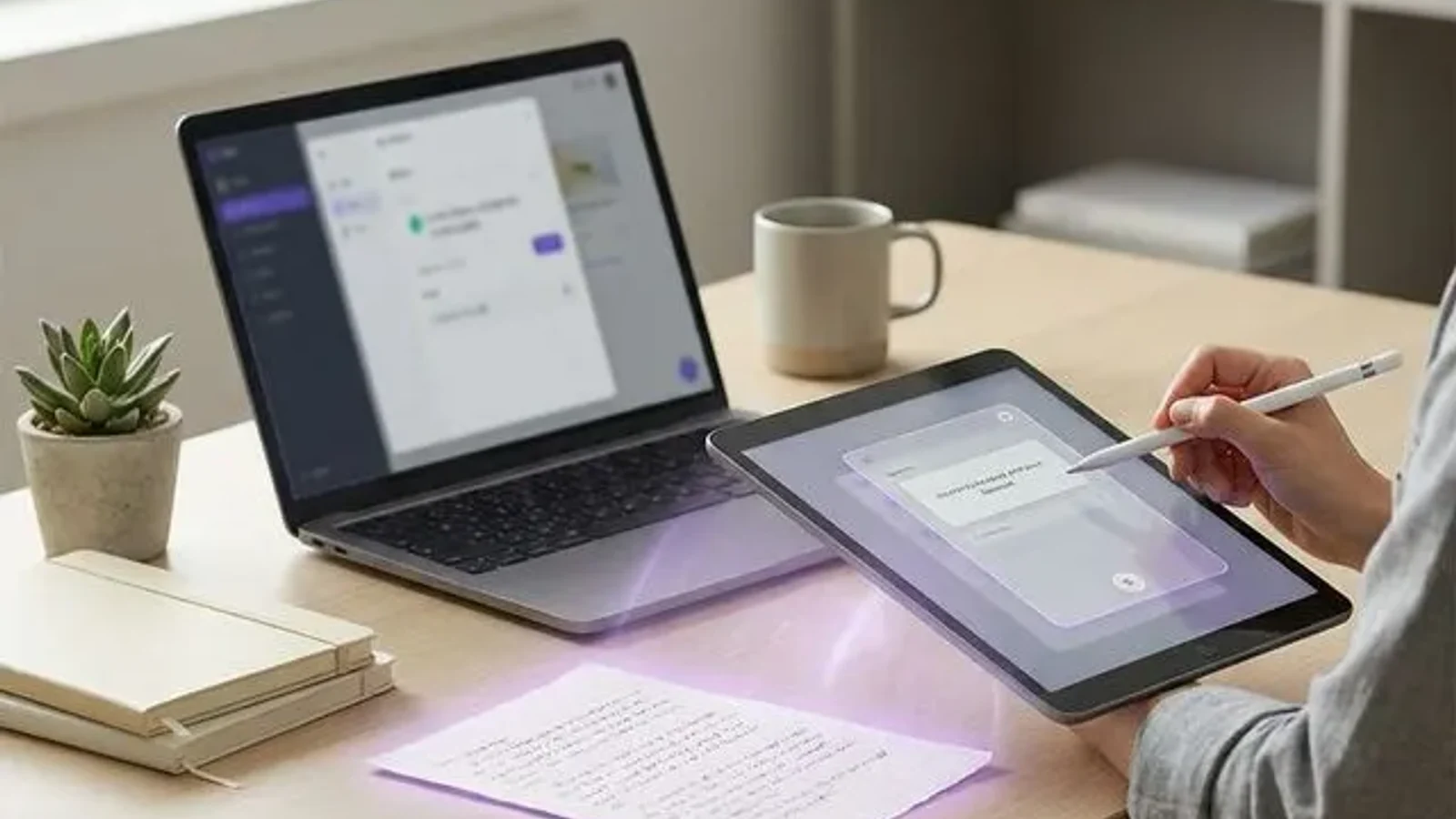
The Note-Taking Illusion: Why Writing is Not Remembering
We have all experienced it. You sit through a two-hour lecture, typing furiously. You emerge with ten pages of beautifully formatted, meticulously color-coded notes. You feel a profound sense of accomplishment. But when the pop quiz arrives the next morning, your mind goes entirely blank. This is the great illusion of note-taking: assuming that the physical act of transcription equates to the cognitive act of learning.
Research in cognitive psychology clearly distinguishes the two. Writing down an elegant ai note taker app generated transcript or doing it manually merely moves information from the professor's mouth to your hard drive. It does absolutely nothing to move that information into your long-term memory. True learning requires a process known as retrieval practice, which forces the brain to pull data outward rather than passively stuffing it inward.
If your study sessions consist purely of reading and rereading over those initial notes, you are falling into a classic cognitive trap known as the 'fluency illusion.' Because the notes look familiar when you read them, your brain tricks you into believing you know the material. The moment the notes are taken away inside the exam hall, the fluency vanishes, and you are left stranded.
The essential paradigm shift every competitive student must make is recognizing that notes are merely raw material. They are the beginning of the workflow, not the end. The real work begins when you convert those notes into a format that challenges you. You must transition your text into active retrieval prompts, and a reliable ai note taker provides the fastest methodology for achieving exactly that.
Leveraging an AI Note Taker App for Instant Conversion
Historically, converting a semester's worth of notes into study tools was a grueling, manual task. Students would spend entire weekends copying and pasting text onto index cards, a task so tedious that many abandoned it halfway through the semester. Today, however, an advanced ai flashcard maker eliminates this friction entirely. The technology bridges the massive gap between capture and review in a matter of seconds.
A modern ai note taker app doesn't just record what is being said; it intelligently analyzes the semantic structure of the text. When you feed your raw notes into these platforms, the underlying algorithms identify the key concepts, the critical dates, the core definitions, and the distinct arguments. It then reformats these elements into highly targeted question-and-answer pairs designed specifically for spaced repetition software.
This automated pipeline fundamentally alters how you spend your study time. Instead of spending your Sunday afternoon generating cards, you are spending your Sunday afternoon actually reviewing them. The cognitive energy previously wasted on administrative data entry is entirely redirected toward active recall. This is why students searching for the best ai note taker prioritize tools that feature seamless flashcard integration over those that merely offer transcription.
When evaluating software for this purpose, you are essentially looking for an engine that understands educational context. A standard summarizer will just give you shorter notes, but a specialized educational tool will proactively generate the exact types of prompts you are likely to see on a midterm exam. It is not just condensing; it is reverse-engineering the exam based on your notes.
Optimizing the Notes to Flashcards Pipeline
Even with automated generation, the quality of your flashcards dictates the quality of your retention. If you feed the ai flashcard maker garbage notes, it will generate garbage flashcards. To get the highest return on your investment, you must structure your initial notes intentionally. Use clear headings, bullet points, and distinct paragraphs to give the AI engine the structural clues it needs to generate accurate prompts.
Once the app has converted your notes to flashcards, your work is not finished. You must curate the generated deck. The AI will likely generate more cards than you strictly need. Go through the newly created deck and aggressively delete or combine cards that cover overly obvious material or overly nuanced trivia that your professor indicated would not be tested. A smaller, highly curated deck is vastly superior to a massive, bloated one.
Furthermore, prioritize cards that test deep understanding rather than simple recognition. Ensure the generated questions force you to differentiate between similar concepts or apply a formula to a hypothetical scenario. If a card asks a simple 'yes or no' question, delete it or modify it to require a full explanatory answer. The more effort it takes to recall the answer, the stronger the memory trace becomes.
Finally, integrate this generated deck immediately into your daily review schedule. Creating the assets is meaningless if you do not expose yourself to them sequentially over time. By combining automated generation with strict daily review blocks, you guarantee that the information captured on Monday is permanently cemented in your brain by Friday.
Checklist: Your Automated Flashcard Workflow
Do not leave your flashcard creation for the week before finals. Integrate this protocol into your daily routine to ensure your study assets are constantly updated and ready for review.
Use this checklist after every major lecture or significant reading assignment to keep your retention strategy aggressively proactive.
- Ensure your raw notes are cleanly formatted with clear headings before processing.
- Import the text into your chosen ai note taker app to initiate the flashcard generation.
- Curate the generated output: delete redundant cards and refine questions for clarity and depth.
- Export the finalized deck to your preferred spaced repetition reviewing environment.
- Complete your first review of the newly generated cards within 24 hours of creation.
FAQ
What makes an ai flashcard maker better than just writing them out by hand?
While some argue writing by hand aids memory, the sheer volume of college material makes it unscalable. An automated tool saves dozens of hours per week. That saved time can be spent actually studying the cards via active recall, which the data proves is far more critical for retention than the initial creation process.
Can the AI understand complex subjects like organic chemistry or legal case studies?
Yes, provided the original notes are clear. The best ai note taker models are trained on vast amounts of academic literature and can recognize highly specific jargon and formulas. However, it is crucial to review the generated cards to ensure nuance wasn't lost during the extraction.
How do I know if the generated questions are actually what will be on the test?
The AI bases the questions entirely on what you feed it. If you feed it notes that highlight the core definitions and major arguments emphasized by the professor, the resulting flashcards will align perfectly with exam expectations. The tool mirrors the priority of your original text.
Will finding the best ai note taker guarantee I get straight As?
Software is a multiplier, not a substitute for effort. Connecting notes to flashcards automatically removes the friction of preparation, but you must still show up every single day and perform the active recall repetitions. The app builds the gym; you still have to lift the weights.
How to Turn Class Notes Into Flashcards Automatically using an AI Note Taker App
Transform raw class notes into active-recall flashcards and daily review sets with a modern ai note taker app.